Households and small businesses face escalating gas bills as demand declines.
Australian household and commercial gas use is expected to decline by 79% by 2045 and to be largely non-existent by 2050 as households and small businesses electrify and leave the gas network.
Our new report, Power Move, looks at how to manage the transition away from gas so it's fair and affordable for all consumers - those who can electrify their homes and businesses, as well as those who face barriers to doing so.
Key findings
- Households and small businesses face escalating gas bills as demand declines.
- Electrification can unlock significant long-term bill savings for households and small businesses.
- Gas network rules are not fit for purpose to manage the transition from gas.
- There is an urgent need and opportunity for Australia to set out a national roadmap for household and small business electrification and actively plan for the future of the gas network.
Household and small business gas demand is in long-term decline
Long-term modelling consistently points in the same direction: gas use in households and small businesses will decline substantially in the next 25 years.
In its forecast for the Integrated System Plan (ISP), CSIRO projects that, “gas use in the residential and commercial sectors approaches zero by 2050” in all scenarios. CSIRO notes that the results are, “consistent with similar decarbonisation scenario modelling studies.” The Australian Government’s Future Gas Strategy states, “households and small businesses will have, for the most part, electrified by 2050.”
These trends are no longer just forecasts: they are reflected in real-world decisions.
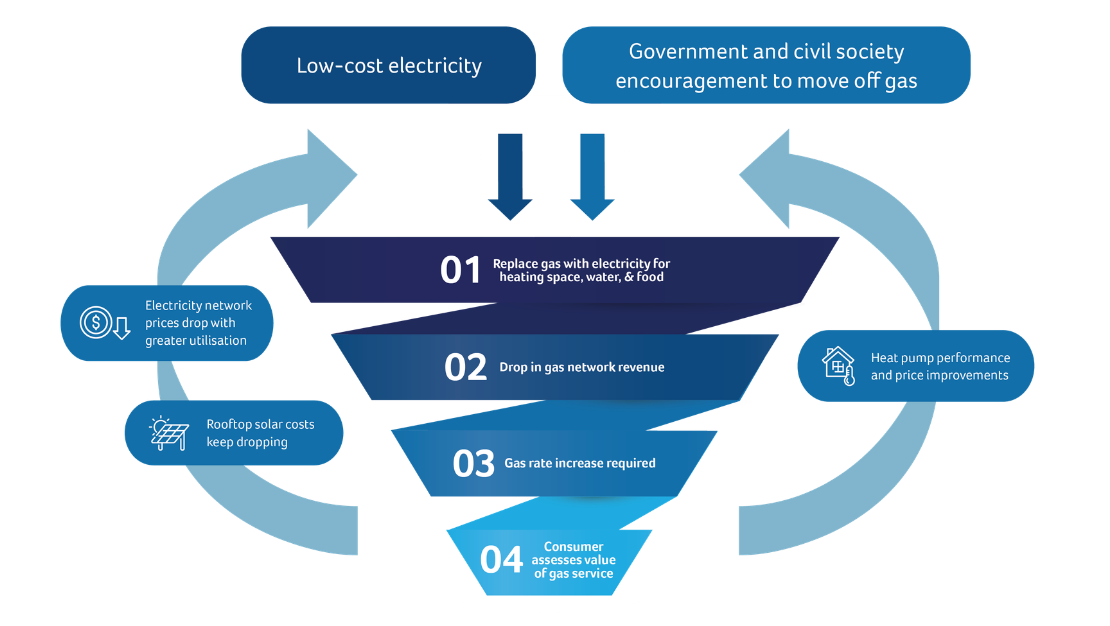
Many consumers will leave the gas network. Those who remain will face escalating bills, even if they reduce their gas use.
Consumers who face barriers to electrification are most at risk
Transitioning away from gas is not just a matter of having the right motivation. For too many people, it often involves navigating a web of structural, financial and operational barriers.
The rising cost of remaining on the reticulated gas network can provide the economic incentive to transition for those able to control – and afford – the cost of switching. However, renters, those in community and social housing, and low-income households, have limited or no control over whether they electrify, even where they might want to transition.
The complex reality for small business
For Australia’s small businesses, these barriers extend even further into the complexities of supply chains, product quality, and daily operations.
The Council of Small Business Organisations Australia (COSBOA) reports that almost half of small businesses (49%) have not yet taken any steps towards the energy transition, while nearly two-thirds (63%) say the cost of transition is difficult to manage.
Recommendations
The federal government and all state and territory governments have committed to net zero by 2050 or earlier, and electrifying households and small businesses are particularly cost-effective emission reduction strategies with net economic benefits.
The key question for governments is not whether the transition will happen, but whether governments will step up to plan and manage an orderly transition, or whether the consumer risks we have highlighted will be allowed to play out with growing consequences for those left behind.
The Australian Government should:
- Set ambitious electrification targets that aim to ensure electrification of all new households and commercial buildings by 2028, all existing social and community housing by 2035, all rental homes by 2040 and all homes by 2050, if not sooner.
- Develop a National Electrification Roadmap that sets out a plan for achieving targets collaboratively across all jurisdictions.
State and territory governments should:
- Develop or align jurisdiction-based targets and plans to ensure they are at least as ambitious as those set out in the National Electrification Roadmap.
The Australian Government and state and territory governments should regularly report against the targets and plan publicly. The Energy and Climate Change Ministerial Council should coordinate nation-wide action to meet these targets.
The Australian Government and state and territory governments should take action to signal electrification to consumers at key decision points:
- Mandate that landlords install efficient electric appliances when a gas appliance fails in rentals.
- Introduce clear labelling of the bill and emissions impacts of gas appliances at point of sale.
- Remove or prohibit rebates, incentives or subsidies to purchase new gas appliances where they are eligible under state-based schemes or offered by gas networks.
- Mandate disclosure of energy performance ratings of properties at point of lease and sale.
- Reform strata legislation to support electrification in multi-unit dwellings.
- Support tradespeople (electricians, plumbers) and strata and property managers to be champions of electrification.
The Australian Government and state and territory governments should implement policies and review existing programs to ensure all Australians are supported with the upfront costs of electrification and energy efficiency upgrades, including to:
- Provide grants and direct finance options for low-income households or illiquid homeowners.
- Expand the Social Housing Energy Performance Initiative (SHEPI) to retrofit all social and community housing to be fully electric and high performing.
- Provide rebates on efficient, electric appliances.
- Provide targeted support for small business electrification.
State and territory governments must actively plan for the transition by:
- Ensuring all new household and small commercial buildings are all-electric.
- Signalling a clear end date for gas for households and small businesses.
- Providing support to reduce the cost consumers face when disconnecting from the gas network.
- The Australian Government should work with state and territory governments to develop plans for the future of gas and align them with net zero targets and a National Electrification Roadmap.
State and territory governments must actively plan for how gas network costs will be shared fairly between consumers, networks and their investors, and taxpayers through the transition. The current approach assumes consumers will continue to fully fund the costs and risks of the transition off gas by default.
The Australian Government should engage with state and territory governments to plan for these costs and consider initiating an independent inquiry (for example by the Productivity Commission or another appropriate body) to ensure these issues can be considered holistically at a national level.
State and territory governments should begin actively exploring and taking a lead role with networks in planning strategic decommissioning of sections of the gas network. This approach can reduce costs and risks for consumers and network investors alike.
State and territory governments and the Energy and Climate Change Ministerial Council should also lead legislative amendments to remove existing barriers to strategic decommissioning.
The Australian Government should work with state and territory governments to explore options for decommissioning and align decommissioning plans with net zero targets and a National Electrification Roadmap.